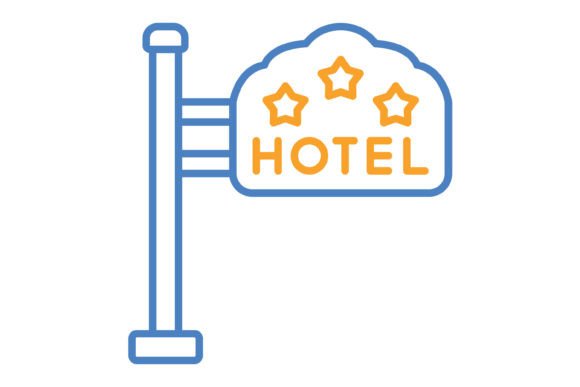
Hotel Sign Blue Orange Line Icon: Integrating Versatile Visuals into Your Digital Projects
In the landscape of digital design and content creation, the difference between a professional project and an amateur one often lies in the details. Visual consistency, clarity of communication, and the seamless integration of assets are paramount. The Hotel Sign Blue Orange Line Icon represents more than just a pictogram of a bed or a door; it is a versatile asset designed to fit into complex workflows, from mobile app development to corporate presentation decks. Understanding how to leverage such a resource—specifically one that comes in a comprehensive Zip file containing AI, EPS, JPG, PNG, and SVG formats—is crucial for creators who value efficiency and quality.
Understanding the Asset: Beyond the Graphic
At first glance, the Hotel Sign Blue Orange Line Icon is a specific visual element. However, its true value lies in its technical composition and adaptability. The "line icon" style is currently the standard for modern User Interface (UI) and User Experience (UX) design because it offers clarity without visual clutter. The specific color combination of blue and orange offers a strategic advantage: blue provides a sense of trust and stability, while orange offers a call-to-action energy. This duality makes the icon effective for highlighting hotel-related features, booking buttons, or travel amenities.
The asset is delivered as part of a set of 100 vector icons, designed for maximum usability. This means it is not a rasterized, pixelated image that degrades upon zooming. Instead, it is mathematically defined vector art. For the end-user, this translates to infinite scalability. Whether you are designing a small favicon for a browser tab or a massive billboard print, the lines remain crisp, and the colors remain true.
Workflow Integration: File Formats and Technical Execution
The most practical aspect of the Hotel Sign Blue Orange Line Icon is the variety of file formats included in the package: AI, EPS, JPG, PNG, and SVG. Understanding when to use each format is a critical step in the production process.
Vector Formats: AI, EPS, and SVG
For projects that require editing, the AI (Adobe Illustrator) and EPS (Encapsulated PostScript) files are the primary working files. These are best used during the creation phase. If you are a graphic designer building a brand identity for a boutique hotel, you would open the AI file to modify the stroke weights, change the blue and orange palette to match the client's specific hex codes, or combine the icon with typography.
The SVG (Scalable Vector Graphics) format is the bridge between design and development. When a web developer needs to place the Hotel Sign icon on a website, SVG is the preferred format. It is lightweight, loads quickly, and can be manipulated via CSS (Cascading Style Sheets) to change color on hover states or animate the icon for better user interaction. For mobile apps, SVGs ensure that the icon looks sharp on both standard screens and high-resolution Retina or 4K displays.
Raster Formats: PNG and JPG
The PNG (Portable Network Graphics) file is essential for immediate implementation where editing software is not available. The package specifies a transparent background, which is vital for layering the icon over colored backgrounds, photos, or other design elements without a white box surrounding it. This is particularly useful for bloggers or social media managers who need to quickly drop an icon into a post or a presentation slide.
The JPG (Joint Photographic Experts Group) format is useful for situations where file size is a concern and transparency is not required, such as email newsletters or certain web banners. While JPGs do not support transparency, they are universally compatible with almost every platform and device.
Practical Application Across Professions
The utility of a high-quality icon set extends across various professional domains. Here is how different segments of the audience can implement this asset:
For UI/UX Designers and App Developers
When designing a travel or booking app, consistency is key. Using the Hotel Sign Blue Orange Line Icon as part of a cohesive design system ensures that the visual language is uniform. Before coding begins, the icon is used in high-fidelity mockups (using the AI or PNG files). During development, the SVG file is integrated into the codebase. Because the set includes 100 icons, designers can maintain a consistent "line style" across the entire application—using the hotel sign for accommodation, perhaps a fork-and-knife icon for dining, and a compass for navigation—all sharing the same line weight and aesthetic.
For Marketers and Content Creators
Marketers often face tight deadlines. Having a ready-to-use asset library saves valuable time. When creating a landing page for a travel deal, the Hotel Sign icon can be used to visually break up text, draw attention to key value propositions (like "24-hour check-in"), or decorate email headers. The blue and orange color scheme is psychologically effective in marketing, known to increase conversion rates when used for call-to-action elements.
For Educators and Presenters
In a corporate presentation or an educational setting, text-heavy slides lead to cognitive overload. Visual cues help the audience process information faster. An educator discussing the hospitality industry or a business owner pitching a hotel renovation project can use the icon to represent concepts visually. The high-quality vector nature ensures that even when projected on a large screen, the icon remains professional and clear.
Optimizing the Design Process
Integrating the Hotel Sign Blue Orange Line Icon effectively requires a bit of preparation. Here are practical tips for smooth implementation:
- Organize Your Assets: Upon unzipping the file, do not leave the assets in your downloads folder. Move them to a dedicated "Assets" or "Library" folder within your project directory. Create subfolders for "Vector," "Web," and "Print" to separate the AI/EPS files from the PNGs and JPGs.
- Batch Processing: If you are using multiple icons from the set of 100, use batch processing tools (available in Adobe Photoshop or Illustrator) to resize the PNGs to the specific dimensions required for your project (e.g., 64x64 pixels for a toolbar icon) to save on file size and loading speed.
- Color Management: While the icon is provided in Blue and Orange, it is designed for easy editing. In a vector editor, use the "Select Same Fill Color" tool to instantly change the palette to match your project's branding guidelines without manually selecting individual anchor points.
Quality Control and Long-Term Usability
One of the features of this icon set is that it is "Ready to use for all devices and platforms." However, quality control is still the responsibility of the implementer. Before finalizing a project, test the icon in its intended environment.
For web use, check the rendering on different browsers (Chrome, Safari, Firefox) to ensure the SVG renders correctly. For print, ensure the vector file is converted to CMYK color mode if the final output is a physical brochure or poster, as RGB colors (typical for screens) may look dull in print. The scalability of the vector file ensures that the "Hotel Sign" will not pixelate, regardless of the print size.
Furthermore, consider accessibility. A line icon, while aesthetically pleasing, can sometimes be difficult for visually impaired users to see if the contrast is too low. When placing the blue and orange icon on a background, use a contrast checker tool to ensure it meets WCAG (Web Content Accessibility Guidelines) standards.
Conclusion
The Hotel Sign Blue Orange Line Icon is a robust tool for modern digital workflows. It bridges the gap between static imagery and dynamic, scalable design. By understanding the specific use cases for the AI, EPS, SVG, PNG, and JPG files, professionals can streamline their production process, ensuring that their mobile apps, websites, print materials, and presentations are not only visually appealing but also technically sound and consistent. For the creator who values efficiency and quality, having a reliable, editable, and versatile icon set is not just a convenience—it is a necessity for professional execution.